Saturday, January 22

Wellness Realized Hits the Streets to "Spread The Love"!

This past Friday I began the realization of a dream I have had for 8 years, ever since I first moved to New York City. I remember being struck and saddened when I first moved here by how many needy people one sees on a day to say basis, and while that number is still higher than we would like to believe, the unfortunate truth is that we start to not see these people; not really. We learn to look away or brush past without stopping when someone on the street or in the subway asks for change, food, or help. We learn to block out the looks, sounds, and smells of those who are living in desperate destitution. We start to find it difficult to pay any attention to because it's too sad, or too offensive, or too annoying in the middle of our busy day- besides, what can we really DO about it, anyway? Don't we have places to be and our own busy lives to live? And aren't we all just struggling to get by, never mind the additional burden of helping someone else?

That's where my dream came in. When I first lived in the city, I was working in the art world and making a startlingly low salary by New York City standards (yay for working in one of the least lucrative career fields in one of the most expensive cities in the world!), so I was making do but barely, with very little money to spare. I had lived in smaller European cities before and had spent significant time in NYC on many visits over the years, and I always took naturally to cities so my adjustment was not difficult. But that doesn't change the fact that all of a sudden seeing homeless and hungry people begging or scavenging on a day to day basis wore on me, both as a newcomer to the city and as a sensitive and empathetic person. While I certainly wasn't in a financial position to donate any real money to speak of, I immediately began to think about how I could come up with a plan to take what I had in terms of money and time and turn it into a way to directly help people who were suffering in New York City. That is when my dream was born, that very first year: to go to the store, purchase basic sandwich supplies that I would turn into packed lunches at home, and hand them out myself to the homeless and hungry in the streets of New York. Nothing fancy or large scale, just what I could afford and do with what time and money I had. But what appealed to me most about it was how direct it was- actually putting food right into the hands of the people who need it. How easy is that? I knew I could do that.

And yet, for some reason, it didn't come to pass. I thought about it a whole lot, for years- it would pop up in my mind, asking me to commit to at least trying it, since I had been wanting to for years. But it always got put off for one reason or another. I would sometimes find myself intentionally carrying around some item of food (a part of my lunch, or leftovers from a restaurant meal) until I saw someone who was needy who I would gladly hand it over to. And every single time, I would think...."You could do this for real. You could follow that dream. What's stopping you? It would be so easy...." And yet it still wouldn't happen. Over the years my hunger for charitable work led me to look into volunteer positions with New York Cares, Meals on Wheels, homes for the elderly in my neighborhood in Brooklyn, and finally I settled on a position volunteering at C.H.I.P.S., the local soup kitchen in Brooklyn, one day a week for 6 months. I was satisfied with having finally settled on one organization and followed through on this impulse, and it was an extremely valuable experience. I was thrilled to be tangibly helping needy people and I was personally benefiting from the perspective that brings, but it was difficult to commit to a regular schedule there, because as a self-employed person my own work schedule is constantly shifting, and also, due to a (very fortunately) large amount of volunteers at this soup kitchen, I sometimes felt there wasn't really that much work for me to do when I was there. I was grateful and impressed at seeing this venerable soup kitchen working so well and helping so many people, but I felt that perhaps my own help could be more effective elsewhere, especially given my scheduling needs.

So that brings us to present day...I have been yearning for years to find a charitable outlet that directly helps and nourishes those in need, while also fitting into a construct that would be workable for me given what I have to offer in terms of money and time. It suddenly became clear to me that it was now time to follow my long held dream, my little organization of one, hitting the streets of NYC to hand out food to the homeless, hungry, and needy. Simple. Real. Perfect. Finally!

The same day I had this realization, several hours earlier before it had come to light, I was walking down a quiet street in Brooklyn and I found a $10 bill sitting discarded in the snow. I looked around, and there was no one anywhere nearby to ask if they had dropped it. I made sure, and then tucked it into my pocket, taking it as a sign of providence and a message to trust that all will be taken care of if we have faith and remain positive. Truth be told, at the exact moment I looked down saw the money I had been harboring real estate worries- my husband and I soon want to upgrade to a different home in the same neighborhood, and I sometimes wonder about how that will actually happen- so this was a much needed message of providence indeed, and I was happy to accept it! No sooner had I picked it up, though, that I began to think about how to constructively use it. What I benefited from was the message of bounty from the universe and the freedom from worry that it brought, but I felt that I wanted to use the money itself towards a charitable cause, in order to give that bounty back into the pool and let it benefit someone else's life in whatever small way it could. Later that evening, when pondering how for many reasons I was missing the charitable outlet in my life since stopping my work at the soup kitchen, I had the realization that it was time to follow my dream. And at that moment I knew exactly what the $10 was for. It would be the financial beginnings of Spread The Love! I began making lists.

Since I never abandoned my original idea and it was always floating around in the back of my mind at any given time, I didn't have to spend much time brainstorming. I knew exactly what I wanted to do. What: Sandwiches. Who: Homeless and hungry people. Where: Streets and subways of New York City. Now, some things had changed- I wasn't yet a certified nutrition professional when this dream first formed, so I did want to make a slight adjustment to the actual content of the sandwiches I'd be handing out in order to deliver optimal nutrition in a simple and easy package. And while I insisted that the food be good quality, it still had to be relatively inexpensive, because I was funding this project myself and I wanted to feed as many people as possible. It also had to remain simple, because part of the beauty of this plan is its pure simplicity and feasibility. Luckily, I had considered all of these things before, which is why I had settled on simple sandwiches; so all that was needed were a few adjustments in keeping with my now honed nutrition philosophy, and with the bonus of a Trader Joe's in my neighborhood for reasonably priced but good quality supplies, I was off and running. The next morning, I went out and bought what I would need: two large loaves of whole multi-grain bread, two jars of sunflower seed butter, two large jars of organic strawberry jam, and two bags of organic apples, along with plastic baggies for the sandwiches and brown paper bags to pack the lunches. I came home and got to work preparing the goods!

So, why did I choose this particular meal? For several reasons. The building blocks of healthy nutrition are complex carbohydrates, protein, fat, fiber, minerals and vitamins. I wanted to make a simple meal that could impart as much of those nutrients as possible, while still remaining relatively inexpensive and easy to transport, which would also not require refrigeration (I knew some people would be saving the food for later and did not have access to refrigeration) or pose a problem for those with certain food allergies and/or dietary constraints. You may not think of this, but some people who are hungry are still vegetarians. Or allergic to nuts. Or don't eat certain animal foods. Or don't digest dairy well. This is one of the valuable lessons I learned at the soup kitchen- just because someone is desperate doesn't mean they don't have their own particular wants and needs, and I wanted to honor those as best I could, especially because this meal takes those considerations in mind and still fits in keeping with my own approach to optimal nutrition which is that a diet based in wholesome, natural plant foods is best for health and wellness.

Whole multi-grain bread, due to its high whole grain content, provides complex carbohydrates for energy and stamina while also offering a high amount of fiber to aid digestion, along with protein which builds tissue and imparts strength, and essential minerals and vitamins offered from the whole grain in the bread. Sunflower seed butter is a handy alternative to nut butters, which are a common allergen, yet looks and tastes exactly the same as peanut butter (albeit more expensive), and offers a great source of easily digestible protein along with a high amount of healthy fat to keep the body nourished and able to carry out all of its multiple organ functions. Sunflower seeds also offer an impressive mineral profile and a decent amount of vitamins; minerals and vitamins are essential to health, bodily function and immune function, and they are often hard to obtain for those who are restricted to an extremely limited food supply. The jam is mostly there for flavor and a small amount of fruit vitamins, so I was sure to pick an organic, low sugar version made from organic strawberries and nothing artificial. The apple is there to provide additional fiber as well as crucial vitamins, namely Vitamin C, which is plentiful in apples and plays an important role in immune health.

As I made these Sunbutter and jam sandwiches , I was aware that I was quite literally "spreading the love" even before I hit the streets to actually Spread The Love, and so in every sandwich I carved a heart on the inside (just like I do when I make one for my husband), and as I pressed each sandwich together I said the words "I Love You" so that my intention and energy would be absorbed into this food and thus received by those eating it. Spread The Love is the name of this project because its purpose is to deliver love and nourishment through an act of kindness to those in need. The name feels absolutely perfect.

Once all the lunches were prepared -16 lunches in total for this first foray- I packed up my bag (and yes, it *happened* to be my love hearts bag, but only because it was the only bag I had that was the right size! we'll call it a happy accident) and set out in the snow to deliver them into the hands that needed them. I decided to stick to the subway trains and platforms first; I figured that would offer me the greatest likelihood of finding the people I was looking for in a concentrated area, especially since it was such a cold and snowy day and that type of weather tends to drive many needy people underground seeking warmth and safety. I plotted a route through some of the largest, busiest subway stations in Manhattan with the most trains coming through- Union Square, Herald Square, Times Square, Port Authority, and others- and at each one I would get off the train and canvas the station, walking up and down each platform for each different train, handing out the lunches to the needy people I found along the way. The first thing I noticed was that, given our learned tendency to overlook needy and homeless people as we are rushing from place to place in our day, I really had to keep my eyes peeled to find them. We are all so accustomed to brushing past the person asking for change, begging for food, or sleeping on the cold hard floor, that our eyes become trained in this aversion...and yet now I was actively seeking them out, looking for them, hoping to find them. And it wasn't as easy as I thought it would be, but I did find them, and as I became enriched from this shift in perspective I committed to not turn away from these people anymore, to be aware of them at all times, and to help them whenever I could.

I decided on some ground rules early on for whom I would approach and how: I decided I would stick to mostly central, populated areas for the sake of safety and also to find people most easily, that I would ask each person before handing them some food in order to establish my intention, show that it was safe and out of kindness, and give them a choice in the matter (one person did actually say no), and that I would only offer food to those who were clearly presenting as needy or homeless by either begging, rummaging through garbage, sleeping on a bench or outside, or otherwise exhibiting a derelict state. This required a willingness to observe carefully, because while some cases were obvious, not all needy people "look" like they are at first glance, and not all people who look unkempt are actually homeless or needy. This was especially the case for a middle aged man I observed, dressed normally in jeans and a jacket, standing around on a half-full subway platform as people buzzed around him or waited for the train...only when he thought no one was looking would he turn around and pick through a large garbage can beside where he lingered, hunting for bits of food or something he could use. When I approached him and said "Excuse me," he looked surprised and frightened, as though he'd been caught in the act and would be in trouble. There was an element of shame as well as fear, until I followed by extending my hand with a brown bag lunch in it and saying "Would you like some food? It's a packed lunch." His face softened with relief first, then realization, and finally gratitude. This reaction played out again and again as I made my ways through first the subways and then the streets of New York. I realized then how often the homeless and needy in large cities are accustomed not only to being ignored by passersby, but to being apprehended in some way, told to move along, or perhaps even chastised. Almost everyone I approached seemed surprised and a little bit taken a back...they were clearly not used to being spoken to or acknowledged, certainly not with kindness.

When I had spent about 2 hours wandering the platforms and trains of the subway stations without yet popping above ground, I decided to hit the streets for a while to see what I could find. I was ready for some fresh air by then and wanted to make sure I found some of the people who were on the streets as well, in order to Spread The Love more thoroughly. When I popped above ground at West 4th Street, the snow was really billowing down and the streets were pretty empty; it was almost evening at that point, and I became concerned that I wouldn't know where to go to find people outside in this weather. I was pretty tired at this point as well, so I decided to just walk a loosely planned route through some populous areas nearby and see what happened. I came across a man in Washington Square Park, sitting on a bench with garbage bags all around him. It was so cold and snowy that he was the only person in the park, besides me. Like most of the people I gave lunches to that day, he thanked me graciously, again and again, and said "God Bless" several times as I walked away smiling at him. I found several more people taking cover under the scaffolding along the lower end of 5th Avenue. I found a seemingly mentally disturbed man sitting at a small table in a Starbucks, staring down at his shaking hands and glancing around nervously while muttering to himself, clearly hoping that no one would notice him and shoo him back out into the cold from which he had found temporary respite. All of these people were approached gently, spoken to kindly, and given a bag of food if they so desired. All but one person accepted.

At the end of the day, it took me almost 4 hours to hand out all of the lunches, but I did not give up until every one was handed out. In the future I will take what I've learned and apply it in order to maximize the number of people I can reach in that time. This is not a one time thing: I have held this dream for a long time, and now that I have realized it, I plan to make it a regular part of my life. I learned a lot from this first experience of Spreading The Love: namely, how the acknowledgement of a suffering person, the speaking of a kind word, the willingness to look, accept, and care, are as important as the actual assistance you are providing. The food was greatly appreciated and much needed by these people, I could tell- but so was the validation of being spoken to kindly by another human being who wasn't just breezing by, unseeing and uncaring. It felt good for me too, of course. I felt tired, and somewhat saddened by what I had seen, but mostly brimming with an immense hope for the myriad possibilities of a small scale approach to helping people- one person at a time. We can all do this in our lives, we can all take part in an exchange of positive energy. There are some images from that day that stay with me: the older Eastern European woman in Union Square subway station, begging in a wheelchair with one hand extended, unable to speak English to thank me but gazing at up at me with tears forming in her eyes and a smile spreading across her aged face. The moving sight of a man sitting all alone in a park covered with stark clean white snow, with only garbage bags of nothing gathered around him for security, but a love in his heart that allowed him to smile broadly and heartily "God Bless" me over and over for helping him.

Spread the Love is going to be a regular part of my world from now on. I don't know yet how often I will do it, but I am committing to maintaining this project going forward. I may be only one person, but I know how much one person can make a difference, and small scale is where big change starts. I will be funding this project myself, but in time, I plan to look into asking some neighborhood businesses if they would be willing to make donations of food for this project. If you yourself feel inclined to help this project along by making a small donation, I would of course be very grateful, as would those on the receiving end of the food I am providing- I promise that any amount, no matter how small, will be completely and efficiently used towards the purchase of food that will be delivered directly into the hands of the needy. If you've been looking for an easy, no hassle way to make a small no-minimum contribution to charity, here's your chance! I will post more in the future about the continuing efforts of Spread The Love, and I hope this story has inspired you to seek out small ways to make big changes in your own communities. Even if by just remembering to acknowledge and dignify all of the souls you come across in life.

I would like to share this video, which is extremely beautiful and moving, and which helped inspire me to follow my own dream with Spread The Love. The actions we take to spread love and caring to those around us contain more power to change the world than anything else: video of the works of Mr. Narayanan Krishnan.

Wednesday, January 12

"Table for One" : The Art of Eating, Alone

These days, with our busy ever-shifting schedules and jam-packed work days, many of us eat at least one meal a day alone- often two. Many of these meals are eaten in the office or workplace, and some of them are eaten at home or in a restaurant of sorts. Even if we live with others or with families, we often don't eat all of our meals with them, either because we don't feel inclined to or because we are all feeling pulled in different directions by our schedules and obligations. Stop for a moment and consider how often you eat alone, and then ask yourself- how you are using that time?

The temptation when eating alone is to immediately seek distraction in the form of something "to do". Because we can't just sit there, eating, ALONE...right? We'll often look for something to read or flip through, something to entertain us and either engage our brains or shut them off such as email, Facebook, blogs online, magazines, or even paperwork for our jobs. If we're at home, we'll often plop down in front of the TV to distract ourselves with whatever shows are on, zoning out as we chew and swallow. What about when we're eating alone in a restaurant without a TV or computer or book nearby? Out comes the cell phone or PDA for some texting or internet surfing, or we dig around for something....ANYTHING....to distract ourselves with. And usually, we gobble down these alone meals fairly quickly, because it's not like it's worth spending any time on a simple old everyday meal just for us, right?

But what are we hiding and rushing away from? Is it that uncomfortable to simply sit, alone, and eat our food? Is it that preposterous to let our meal itself, and the act of enjoying it and receiving it, be all the stimulation we need? Well, yes, it can be that uncomfortable and seem odd....at first. That's because we aren't used to it, and we are no longer conditioned to view the art of eating as something intimate, pleasureable, and worthy of our full attention, especially when we are eating alone. Why shouldn't you get just as much enjoyment, pleasure, and relaxation out of a meal eaten alone as you do when dining with others or when celebrating a special occasion? Eating is about nourishment including but not limited to the food itself, and in order to get the most out of your meals both physically and emotionally, you need to honor your meal times as a special time in your day for relaxation, reflection, and pleasure; even when eating alone.

It's a well known fact that rushing through a meal by hastily chewing and gulping down your food results in discomfort, gas, bloating, and acid indigestion. But many people aren't aware that this rushed approach to eating actually hinders your ability to digest your food, assimilate your nutrients, and maintain an efficient metabolism. When we're eating fast, the digestive system does not have time to adequately and effectively process what we are taking in so we miss crucial steps of the digestion and assimilation cycle, meanwhile the body receives the message that we are in a state of stress or emergency and responds by releasing stress hormones that trigger a "fight or flight" response, causing the body to pause the metabolism of energy to focus on the "emergency" at hand. That's right: eating fast--> lack of digestion and assimilation --> stress response --> the shut-down of calorie and fat burning.

When we eat in a distracted state, there is a similar effect: our bodies and minds are so interwoven that when we are mentally focusing on something other than the art of eating what is in front of us, our bodies lose focus on the act of digesting, assimilating, and metabolizing our food. While we may think we are master multi-taskers, the fact is that you can't be working on a report on your computer while absent mindedly munching on a sandwich and getting the same level of benefit from that sandwich in terms of digestion and satisfaction as you would if you were eating it slowly and paying attention to the fact that this is your time to refuel, and that it in and of itself deserves to be a priority. When we don't give ourselves the space and attention to emotionally and mentally engage fully with the act of eating, we miss out on a crucial part of the eating experience both physically and emotionally and thus wind up unsatisfied, tired, groggy, and feeling deprived of true enjoyment of our food, resulting in everything from overeating to cravings for sweets and stimulants to an overall disillusion with the pleasure of eating.

There are two parts to the nourishment picture: the nutrients and energy in our food that are absorbed into our bodies, and the emotional and mental satisfaction that comes from deriving pleasure and sensation from the act of eating. Make no mistake: both parts are equally important and both play an equal role in balancing health, weight, and fitness. In truth, they are two parts of a whole: nourishment is not only physical or emotional/mental; it's both, and you can't ignore one or the other. If you're having trouble losing weight or maintaining your energy or you just don't feel well after you eat, ask yourself how you eat as well as what you eat. Whether you are eating by yourself or in a group, focus on actually eating your food and let yourself pay attention and enjoy it. Don't succumb to the temptation to rush through or distract yourself. You do deserve to take your time, relax, chew and swallow, and derive real pleasure from your meal.... every meal... whether you're eating alone or in the company of others. Not only do you deserve it, but you need it in order to effectively digest your food and feel truly satisfied with your experience of eating.

So how about some tips for how to make meal time sacred, relaxed and enjoyable, even when dining alone?

At home:

- Sit at at the table, not on the couch. This is a real meal like any other, even though you're alone. You don't need the TV or computer for company, you can be your own company.

- Make use of simple things that signify "dining" or "special" or "relaxation", such as a cloth napkin, a fancy glass for water, a lit candle, or some background music that makes you happy or relaxed. You may be thinking how silly it sounds, but trust me: creating the environment makes a big difference.

- Say a word of thanks before your meal. This does not have to be a prayer or anything religious. Simply having a moment of gratitude before you receive a gift to yourself puts you in the prime place for effectively using and appreciating that gift.

- Practice getting to know the food that is in front of you. Notice the sight, taste, texture, smell of your food as you are eating. This awareness is very significant to your enjoyment of and therefore satisfaction from and digestion of the meal. As my husband heard somewhere, "you take the first bite with your eyes". Or your nose, or your fingers. Engage in your eating and you'll get so much more from it!

-Breathe. This is so important. Taking deep breaths instantly slows us down, calms us within, and sends the message to the body that there is no emergency and therefore no need to tense up and pause metabolism, not to mention that adequate oxygen is essential for digestion and all other bodily processes.

In The Office or Workplace:

- If you can, leave your work area and take your meal to a common area like a lounge or even better to a park or bench outside, weather permitting. The idea is to get some separation (mentally and physically) from your work space if possible, so that you can focus on your meal.

- If you have to eat at your desk or in your office, pull a chair over to the window if you have one, or at the very least turn away from your computer and resolve to not check email, answer phones, or look through papers during your meal.

- Set aside a minimum of 20 to 30 minutes to eat your meal, and ask that anyone coming in to talk to you about work matters comes back when you're finished. You may feel uncomfortable requesting this, but think about what you're asking: a small window of time to engage in and enjoy one of the ONLY essential things we all NEED to do every day. In that context, it's not too much to ask.


As someone who works mostly from home and generally eats two of my three meals a day alone, I find that some of my best ideas, introspective insights, and refreshing periods of calm come during my meals alone. I have come to value those mealtimes as much as I do eating out with others or having a special meal with my husband. Eating is about fun, pleasure, joy, and sensuality, and you deserve to experience that regardless of the situation. Yes, it does take practice, and commitment, and there are times when it would be easier or more convenient to just grab and go, but that's not what your body wants or what your soul needs, and it isn't going to allow you to lose weight, increase your energy, feel better in your body, and just enjoy yourself. Think about it....we all love to eat, so why not give it the sweet spotlight, even when you're by yourself?

Wednesday, October 27

Amaranth and Apple Porridge with Chopped Pecans

I have spoken before on the joys, wisdoms, and powers of a whole grain breakfast including how to work with whole grains in their original form to make nutritious and delicious grain porridges. This recipe is a perfect example, and it was the perfect fix for the cold, grey, drizzly day when I recently made it. What we eat for breakfast sets the tone for the whole day, both physically and emotionally, so make sure you get off to the right start with a meal that is grounding, full of the nutrients your body needs for your busy day, and soothing and comforting to boot.

Amaranth is a lesser known but stellar whole grain that is similar in appearance, taste, and nutritional profile to a tiny version of quinoa, although the consistency and texture when cooked is more like grits. It is packed with minerals and is higher in protein and calcium than milk, while containing the magnesium and silicon essential to support calcium absorption. This tiny, tasty treat is one of my favorite things to cook in The World's Tiniest Kitchen.


Amaranth and Apple Porridge with Chopped Pecans

makes 2-3 servings (can be reheated on the stove for subsequent days)

2/3 cup uncooked amaranth (available at natural food stores)
2 cups fresh water
1 medium apple
4-6 tablespoons chopped raw pecans, plain (or 2 tbsp per serving)
cinammon
agave nectar, raw honey, or pure natural maple syrup
unsweetened almond milk
sea salt

Wash the amaranth carefully with your hands in a medium sized pot with plenty of water. The tiny grains will stick to your hands a bit, but just keep rinsing them off in the water. Then drain the amaranth carefully through the finest mesh sieve- you will need this, otherwise the tiny grains will slip through the holes of your strainer- and rinse well. Transfer the washed amaranth back into the pot with 2 cups of fresh water. Wash, core, and chop the apple into small pieces, and add to the amaranth in the pot. Bring to a boil uncovered, then immediately turn down to low, cover, and simmer covered for 20 minutes or so. Check the consistency and give a stir- it is done when the apple is soft and the grain has absorbed the water and turned to a grits-like consistency. If the grains are appearing wet on top but sticking to the bottom of the pan when you try to stir, turn the heat off and leave the porridge to sit covered on the stove for another 5-10 minutes. The steam and moisture will unstick the grains on the bottom. Now you're ready to dress it up!

This recipe makes 2-3 servings, so either portion out what you want for yourself and save the rest to reheat on the stove for the next day or two (when reheating add a little extra water if necessary), or portion into 2 to 3 bowls for yourself and your breakfast companions. Top each serving with 2 tbsp. chopped pecans, a healthy shake of cinnamon, a very light swirl of either agave nectar, raw honey or pure maple syrup (remember the porridge is already sweetened by the cooked apple, so you don't need much) and a subtle sprinkling of sea salt to balance the sweetness and bring out all the flavors. You're ready to spoon into some heavenly Fall in a Bowl! But...


For the final act, if you are so inclined, you can top it off with a gentle pour of unsweetened almond milk, which gives an extra creamy and smooth texture to this already comfortingly soft and sweet dish. It's delicious with it, but perfectly adequate without- chef's choice!


Interested in finding out more about what foods are right for your own body and why? Looking for personalized information and support to help you change your eating and lifestyle choices in order to achieve your own specific goals for health and wellness? Contact me to set up a consultation: erica@wellnessrealized.com

Tuesday, October 26

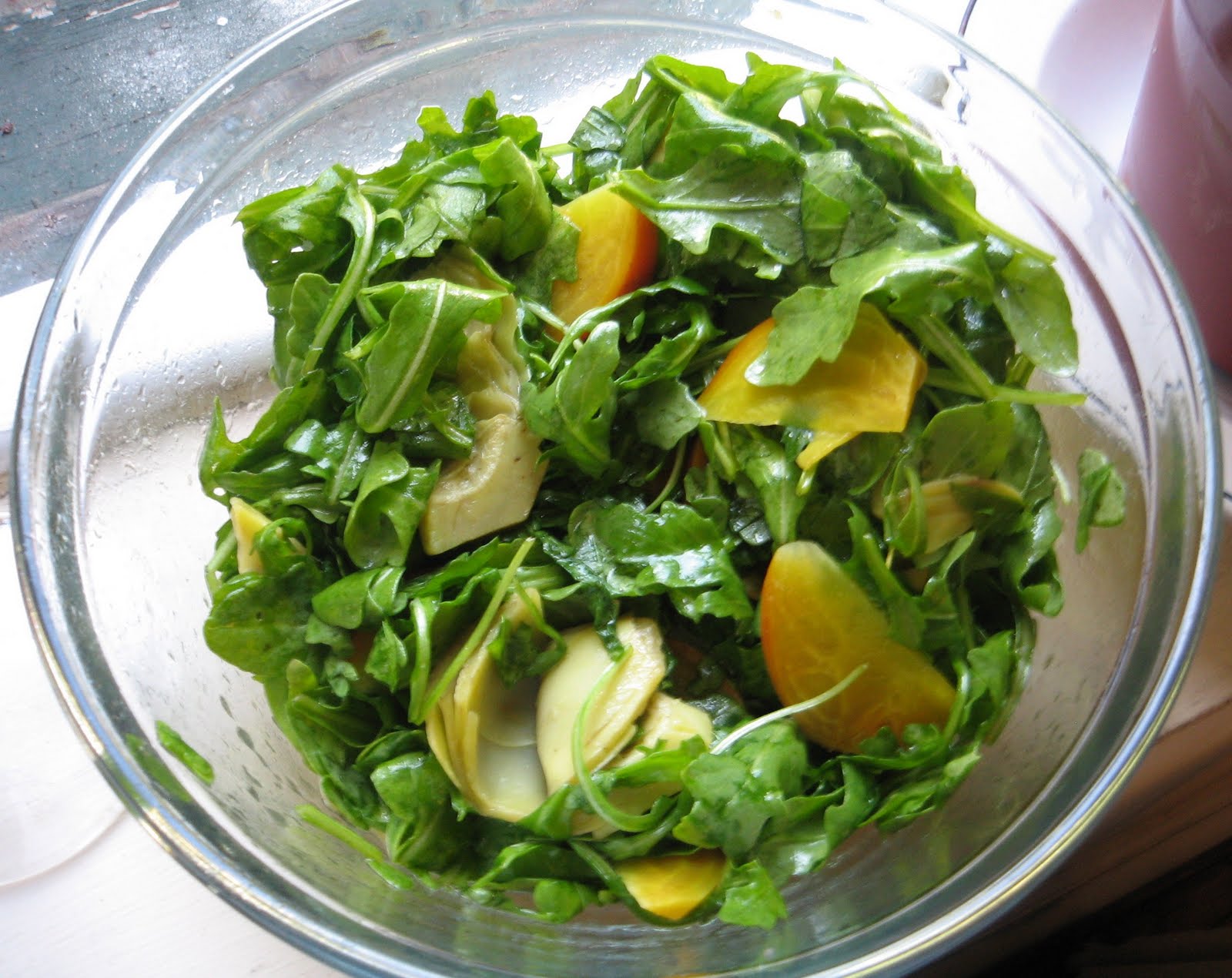
Tortilla Bean Casserole and Arugula Salad with Golden Beets and Artichoke Hearts

I think we can all universally agree that once the wind starts blowing and the leaves start falling, it's time for comfort food! Well, it's always time for comfort food, but this is the time of year when we start to yearn for something warm and hearty; something deep and flavorful that's been baking in the oven or simmering on the stove. In the World's Tiniest Kitchen, that means it is time once again for Tortilla Bean Casserole.

I have a warm spot in my heart (and my stomach) for Tortilla Bean Casserole, because it is one of the first dishes I created back when my husband and I first moved in together and I was learning the ropes of how to cook for two people who had somewhat disparate food habits, while also sticking to a conservative budget and not spending too much time in the kitchen (this was when The World's Tiniest Kitchen itself was also new to me, I had to adjust).

Enter Tortilla Bean Casserole. I like to call it a Crowd Pleaser, which in my book means any dish I can bring to an extended family gathering or a potluck dinner with friends where I won't get the "oh, more healthy stuff?" routine because it'll be gobbled and gone before anyone thinks to raise an eyebrow. It's also super easy, so it's a great recipe for anyone who doesn't have much experience in the kitchen. Today was the perfect day to cook up a big pan of this dish, and for a light and refreshing contrast, I served it with my Arugula Salad with Golden Beets and Artichokes, recipe below.

Tortilla Bean Casserole

serves 6-8

2 cups uncooked beans, either kidney and black beans or kidney beans and black eyed peas
(canned beans can be used if necessary, see note below on cooking beans)
1 package sprouted grain corn tortillas (ex: Food for Life brand, available at health food stores)
1 jar all natural, low sodium/no salt added tomato sauce
1 1/2 cups organic frozen sweetcorn
1 large onion
2 tbsp olive oil
Spices:
Garlic Powder
Chili Powder
All Spice
Sea Salt
Black Pepper


Soak, wash, and cook beans according to instructions on how and why to cook your own beans here. If using canned beans, you will need at least 2 cans of each kind of bean (4 cans total), and be sure to rinse them well in water. Once beans are ready, set aside. Chop the onion into small pieces, place in a saute pan with tbsp olive oil, and saute over medium -low heat until fragrant and translucent. Set aside. In a large saucepan, heat the jar of tomato sauce over medium heat until slightly bubbly, add the beans, corn, onions, 1 tsp. chili powder and 1/2 tsp. garlic powder, a sprinkle of allspice, sea salt, and black pepper. Simmer on medium to low heat for 15-20 minutes minutes. Taste and adjust seasoning.

Preheat the oven to 375 degrees. In a roughly 10" x 13" casserole pan, ladle about 1/3 of the bean mixture into the bottom and spread it out to form one thin, even layer across the bottom of the pan. Top with one single layer of the corn tortillas, covering the entire surface but not overlapping much- tear them into pieces when you need to cover smaller areas. Then top that with another 1/3 of the bean mixture spread into a thin, even layer, and top that with another solid single layer of tortillas. Spread the remaining 1/3 of the bean mixture over the tortillas in an even layer, and top with the last layer of tortillas. You now have 3 alternating layers of each, and the package of tortillas should provide just enough. Press the top layer or tortillas down a little so that they get "wet" with sauce on one side, and then turn them over and re-layer them with the other side facing down so that the top is now moist. Drizzle this top crust of tortillas with 1 tbsp olive oil and use the back of a spoon to spread it evenly to coat each tortilla. For an extra kick, I also drizzled the top layer with a tiny bit of cider vinegar-based all natural barbecue sauce left over from a trip to North Carolina, if you want to get crafty and try that! Otherwise, you're ready to go. Place in the oven and bake at 375 degrees for 30-35 minutes, until it looks like this:


Mmmmmmmmmmmm......sizzly.


Cut into square pieces as you would lasagne and remove each serving from the pan carefully with a spatula. This makes enough for 6-8 people and is GREAT as leftovers (add some additional tomato sauce when reheating if leftovers seem dry); it freezes well, too, so don't worry if you're making this for just one or two people- plenty to freeze and heat up another time! According to my husband, it tastes best when reheated as leftovers, and that fact plus it's easy transportability makes this is a perfect bring-leftovers-for-lunch meal. Throw some veggies on the side and you're all set!

Speaking of veggies, I served it with....

Arugula Salad with Golden Beets and Artichoke Hearts

3-4 cups baby arugula
8 pieces frozen artichoke hearts (or roughly 2 large whole artichoke hearts quartered, if using fresh)
1 medium/small golden beet
olive oil
cider vinegar
sea salt
pepper


Wash arugula and spin dry in salad spinner or pat dry with paper towel, place in a salad bowl with room to toss. Scrub beet well, remove rough top, and trim any tough skin around the top, along with the skinniest part of the root if still attached. Cut in half lengthwise and then into small half-moon segments as shown in photo. Place into a shallow saute pan with 1 inch water (along with artichoke hearts if using frozen), bring to a boil, turn to medium heat and simmer for 7-8 minutes. (If using fresh cooked artichoke hearts, cook beets alone). Drain and cool beets and artichoke hearts, toss in with arugula. Drizzle with olive oil and cider
vinegar, a sprinkle of sea salt and pepper, and toss well to coat.


Voila!

This salad is the perfect light, simple, and refreshing accompaniment to the warm, dense layers of the tortilla casserole, but it can be served alongside any dish you like.


So there you have it...a delicious Fall meal, from the World's Tiniest Kitchen to your table. Pull up a seat and dig in!


Interested in finding out more about what foods are right for your own body and why? Looking for personalized information and support to help you change your eating and lifestyle choices in order to achieve your own specific goals for health and wellness? Contact me to set up a consultation: erica@wellnessrealized.com


Friday, October 22

How, and Why, to Soak and Cook Your Own Beans


There's always a pot of beans soaking or cooking in The World's Tiniest Kitchen, and if I can do it here, trust me- you can do it anywhere! Cooking your own beans is easy, the most nutritious choice, cheaper by a long shot than buying canned beans, and despite popular belief, it's not actually time consuming. "Time consuming" means that something is taking up your time or taking time away from other tasks, and when it comes to soaking and cooking beans, it's rather a matter of very short periods of actual time spent interspersed with long periods of time when the beans are doing all the work and you don't even need to be in the room. So when you're ready to make that step and see just how easy, cheap, and deliciously nutritious homemade beans can be, read on!

Let's start with the why: when it comes to the intrinsic energy and quality of our food, we always want to consume food that is as close as possible to it's original state, when it came from the earth. Dried beans have simply been dried in their natural state and then sold- no salt or other preservatives, no chemicals or additives or flavorings, and no sitting around in liquid inside a can for long periods of time. Because they exist in this simplest of states and nothing has been added to them or done with them, they are also very cheap to buy in comparison with canned beans. You buy them in bulk, store them in airtight containers in a cupboard or on a shelf, and they last for months and even years! Aside from that, home cooked beans are easier to digest because the process of soaking and careful cooking descreases their gas-causing tendencies, so if you've experienced gas or indigestion with beans in the past, it's time to give home cooked beans a try.

And now for the how: simply measure out the dried beans you want to use depending on the recipe or use you have in mind, figuring that one cup of dried beans will feed about 3-4 people or servings. Place them in the bottom of a pot or bowl that has a lid, and cover them with plenty of fresh lukewarm water (at least twice as much water to beans). Add in either a bay leaf or a small strip of kombu seaweed (available at health food stores and Asian markets) to help break down the gas causing components of the beans, and nestle it under the beans. Cover with the lid, and leave for 8-10 hours. An ideal time to do this is either before you leave for work for the day so you can cook them when you get home, or before you go to bed at night so you can cook them the following morning or afternoon. Work and sleep are chunks of time already in your day when cooking prep like this can be happening on the side, with no effort! The time of soaking doesn't have to be exact- if you soak them for a little bit less than 8 hours or longer than 10 hours, that's ok, but don't soak them for up to 24 hours or more because they will start to sprout. During the soaking time, you don't do anything with them at all, you can be sleeping or not even home- meaning it takes less than 5 minutes total to measure them out, add water and a bay leaf or kombu strip and cover them, and you spend the next 8-10 hours the way you would anyway. See? Not bad so far.

After they've soaked 8-10 hours, drain them in a collander, discard the soaking water, and rinse them very well with fresh water. Reserve the bay leaf or kombu strip for cooking. Place the bay leaf or kombu strip at the bottom of a large pot with a heavy lid (enamel or cast iron pots work well), and top with the soaked washed beans as well as 3 times the amount of water per the amount of dried beans when you started, i.e. 3 cups of water if you started with one cup of dried beans before you soaked them. Bring to a boil uncovered and leave to boil uncovered for 15 minutes, occasionally checking on them and skimming off any foam that has formed on the surface of the water, discarding the foam. The longer you soaked the beans, the less foam there will be, if any. Then turn down the heat to low, cover the pot with the heavy lid, and simmer for a minimum of 1 hour and up to 90 minutes, depending on the kind of beans you are using (some are harder) and how long you soaked for (longer soaking shortens cooking time).

During this time, you don't need to be in the room watching them; they're just bubbling away on the stove- so while 60-90 minutes sounds like a long time, you're not actively cooking during that time at all. You can be in the other room helping with homework or showering and dressing for the day and tidying the house or answering emails. It's not an exact science when it comes to the length cooking time (are you seeing the pattern here? beans aren't fussy!) - the beans are done when they feel very soft to the touch and to the bite, but not mush. This means a minimum of one hour, but remember that well cooked beans are much easier to digest, so if you are someone who has often had indigestion with beans in the past, go for the full 90 minutes.

When finished cooking, strain and proceed to use in your recipe. However if you are cooking the beans for multiple uses over the course of one to several days, keep them in their cooking liquid in a glass or ceramic container with a lid in the refrigerator and strain out servings as you need them- the liquid keeps them from drying out. Home cooked beans can be kept in the refrigerator for 3-4 days, and can also be frozen for use at a later time. They are wonderfully handy to throw into soups, stews, casseroles, stir fries, salads, and all types of home cooked dishes.

So all told, the process of making beans from scratch does take hours- but you're only actively cooking or working for about 30 minutes of that. Once you get the hang of it, you'll be amazed at how easy it is and how you don't even notice the time passing, because you're doing your own thing the whole time and the beans are doing the work!

You will find that between the soaking, the bay leaf/kombu strip, the skimming off the foam, and the long cooking time, the beans are much easier for your body to digest than the ones being cooked en masse by a food manufacturer and sealed into a can with preservatives. Not to mention that home cooked beans save you a ton of money, and are better tasting and more pleasing in texture than beans out of a can, and best of all, you're giving your body this food in its closest to original state, which is always ideal. Closest to the source is best of course!

(All of this being said, canned beans are convenient, and it's ok to use them when you need to- but it's best to make your own whenever you can. If you do need to use canned beans or would like to simply have a few cans on hand for times when you haven't gotten a chance to make your own, buy a brand such as Eden Organics, which uses a safe can lining, avoids preservatives and additives, and includes kombu seaweed in their ingredients.)

Interested in finding out more about what foods are right for your own body and why? Looking for personalized information and support to help you change your eating and lifestyle choices in order to achieve your own specific goals for health and wellness? Contact me to set up a consultation: erica@wellnessrealized.com

Monday, October 11

Upgrade your Oatmeal


So it's Fall again, and that's good news for Breakfast! Cooler temperatures mean that we are more inclined to seek something warming and hearty for breakfast, and the best bet for a hearty, healthy start to the day is a whole grain porridge. So why is this such good news? Because whole grains are one of the essential foods most lacking in the modern American diet, and they are absolute nutrition powerhouses- packed with protein, fiber, minerals, and energy, these grains are essential for everything from brain function to digestion to blood sugar regulation and energy maintenance. And what better way to start the day that with a bowl of such powerful goodness? I have given an all-purpose description and recipe for whole grain breakfast porridge here and also described a tasty version in the recipe for Breakfast of Champions , so check out those posts for how-to's on incorporating this healthy staple into your breakfast routine. The sky is the limit: you can use leftover cooked grains and add more water, you can cook the porridge from scratch in the morning, or you can cook it the night before and make enough for a few days at a time and just reheat a portion each morning if you find yourself strapped for time.

So what about the ubiquitous oatmeal? Most of you have had it, and many of you eat oatmeal on a somewhat regular basis as a healthy breakfast option. But, unfortunately, all oatmeal is not created equal. Cooking oats from their original state and eating them as a porridge will get you the same wonderful health benefits as the other whole grains described in the posts above, but simply microwaving up a packet of sugary, pre-flaked, preservative- and artificial flavor-laden oat bits isn't much better than reaching for a box of sugary, processed cereal. Many of my clients come to me and say they've been eating oatmeal, but using this quick-fix version because they don't have the time to make longer cooking oats, i.e. whole grain oats. But they find out from me soon enough that they are missing out, both on nutrition and taste! So luckily, I have a solution for them, and for you.

Steel Cut oatmeal, which some of you may already be familiar with, is not the hassle that you may think. Switching from the pre-flaked, processed and heavily sugared and flavored packets of oatmeal to plain steel cut oatmeal that you make yourself gains you the bounty of health benefits described above, while also delivering a much more satisfying, filling, and delicious breakfast. And don't worry, it won't be boring! Instead of banking on artificial flavors and sugars, you'll be sassing up your oatmeal with wholesome, natural toppings. But first, let's make the oatmeal:

Simply measure out 2-3 servings (each serving is 1/4 - 1/3 of a cup of dry steel cut oats), and wash well with warm water in a pot, rubbing the grains between your hands in the water for several minutes, then drain and rinse in a fine mesh sieve (this is essential for cooking with whole grains because it removes the phytic acid inherent in the grain). If you have the time to soak the oats for several hours before washing and cooking, even better, but washing well is fine- no excuses about not having time! Then, boil four times the amount of water to the total amount of oats (i.e. 4 cups of water for 1 cup uncooked oats, yielding 3-4 servings). Once the water is boiling, add the oats, turn down to medium-low and simmer for 30 minutes until a uniform, creamy, grainy texture. Done!

BUT, it gets better....I can hear you now saying "I don't have 30 minutes in the morning to cook breakfast!" and that's fine, many of us don't. But you don't need to miss out: simply switch the cooking time to the night before when you do have some free time, and then reheat on the stove in the same pot the next morning for breakfast, OR, try this nifty trick employed sometimes by myself and many of my clients: go through the initial steps above, but once the water is boiling and you add the oats, simply cover the pot and turn off the heat immediately, leaving the hot pot on the stove covered until morning. The oats cook themselves in that very hot water during the night, meaning no waiting 30 minutes for it to finish; by morning, it's done and simply needs to be reheated for 5 minutes in the same pot on the stove. You can make breakfast for the whole family this way! If you are just making it for yourself, you can still make enough for several servings and reheat on the stove for the next several days (3 days max).

Once you've got your upgraded oatmeal, proceed to the flavor station. Remember from the post on Going With the Grain that the ideal breakfast contains whole grain carbs along with protein and some healthy fat for long term energy and satiation, so a great topping for whole grain, home-cooked oatmeal is a spoonful of chopped nuts, toasted seeds like pumpkin or sunflower, or ground seeds like flax. To kick up the flavor, you can go sweet with a light drizzle of honey, maple syrup, agave or brown rice syrup, or try a sprinkling of dried fruit like raisins or dried blueberries instead. If you like it salty and want to experience how grounding and stabilizing a savory grain breakfast can be, sprinkle some sea salt or seaweed flakes. Be creative!

Once you try this version of the old favorite oatmeal, I think you'll be converted, and you'll see and feel the benefits in your body. Remember, if you try the cook-during-the-night version, this literally only takes minutes from your day! Isn't it worth it for a breakfast that is better in every way?

Interested in finding out more about what foods are right for your own body and why? Looking for personalized information and support to help you change your eating and lifestyle choices in order to achieve your own specific goals for health and wellness? Contact me to set up a consultation: erica@wellnessrealized.com

Monday, September 27

What Women Love About Getting Older- Wellness Realized on iVillage.com!

I was recently asked by the lovely ladies over at NBC's iVillage.com to participate in a feature on what women of various ages, lifestyles, and careers enjoy about the process of getting older. The feature is intended to inspire and empower women to view the process of aging as a positive thing; a journey of learning, maturing, and growth where one gains the experience, confidence and knowledge of oneself necessary to pursue a life that is truly in line with one's dreams, aspirations, and desires. I am excited to be part of this feel-good feature and I think it turned out wonderfully, I hope you'll enjoy it too! This iVillage.com link is to my profile in the feature, but there are 12 women profiled in total, so make sure to scroll through and read the others for additional inspiration!

Interested in finding out more about what foods are right for your own body and why? Looking for personalized information and support to help you change your eating and lifestyle choices in order to achieve your own specific goals for health and wellness? Contact me to set up a consultation: erica@wellnessrealized.com

Friday, September 24

A Little Patience....Yeah....

Yes, I just referenced Guns n' Roses in a blog post. Welcome to the Big Show.

Patience: it's one of the essential elements in a peaceful life, and yet it is sorely lacking in how we interact with others and how we interact with ourselves in modern times. I am sure you could look around yourself today and point out a number of instances where a little loving patience could have easily smoothed out a difficult or unpleasant situation: either while stuck in traffic on your way to work, or bustling with the crowds onto the subway, or waiting in line at the deli, or working on a project in the office. New Yorkers are especially gripped by the Disease of Speed, but it's happening everywhere: these days, we expect everything to move and work and travel at lightning speed, and we extend that expectation to ourselves when it comes to things we are trying to learn, embrace, improve on, or become successful at. While you may be able to admit that you could have been a little more patient with that car driving a bit slowly in front of you on the road this morning, or that person who was confusedly swiping their faulty Metrocard and holding up the line, or the server at the deli fumbling with the change, or even your coworker who didn't get you that report you needed right when you asked for it for your project, when was the last time that you looked at yourself and realized how far a little loving patience could go? Or have you ever acknowledged how much you are depriving yourself of it?

We all have aspirations and expectations for ourselves. You can call them dreams, goals, whatever you want. We think about them, daydream about them, plan for them, motivate ourselves towards them, and seek encouragement to reach for them. However, more often than not in this process, we are employing resolutely negative thoughts or feelings about ourselves in order to propel us forward to this desired goal or dream. For example: "I need to learn to eat more healthfully, because I am overweight and unattractive", or "I need to go to the gym 5 days a week, because I am flabby and my body isn't strong", or "I need to work harder and get a promotion, because I am not making enough money or holding an impressive enough position in my career", or "I need to re-organize and re-decorate my home, because I haven't done a nice enough job setting up my environment and I'm too sloppy". We then drive ourselves relentlessly towards these insufficiency-based goals. What's the common thread here? It all comes down to "I need to change, because I'm not good enough as I am. And I need to change fast, NOW." So where's the problem? Deep down inside, we don't like being told that we aren't good enough, by others or ourselves; it causes a pain that resides deep within, a pain that we may be unaware of but that is very real and that results in procrastination and resistance towards the very imperatives that we feel so compelled to fix, change, and improve about ourselves. Do you hear an echo of yourself in the above statements? And if so, how's that "self-improvement" project going??? Let me guess....it's not working out very well. But you're ON IT, right?

Instead of ceaseless criticism and a constant driving pressure to be better, faster, more, less, stronger, richer, higher, prettier, what if we just focused on sending love, kindness, and patience to ourselves right where we are in the quest for our desires, accepting ourselves fully for wherever we are in the process...and then approached our dreams and aspirations from a place of wanting to grow and learn naturally, according to our current capabilities and at the pace that is right for us, by standards that we ourselves define according to what comes intuitively? Doesn't that sound a whole lot easier, more pleasant, and more realistic as a method of actually getting what or where we want?

I'll give you a personal example: I love yoga. I Love Yoga. If you've worked with me as a client, you probably know how I feel about yoga; its transformative powers, and its unique ability to combine a spiritual, emotional, and physical practice seamlessly into one awe-inspiring, mind-and-heart opening, body-toning, spirit-soothing soul shakedown party. You get the idea? I'm into it. I learned about yoga from my Mom. My Mom was doing yoga when I was a little girl, way before it was so fashionable, and that's how I first came to know yoga and the wonderful secrets and powers that it promised. My Mom brought me with her to a yoga class when I was so young that my memories are hazy...but what I do remember is this: the teacher was soft-spoken, gentle and kind, there were green plants around the room, the other practitioners were open and welcoming to a curious but shy child in their midst, morning sunlight was streaming through windows into a quiet and warm space, and I saw my Mom in a light that I had never seen her in before: she was ensconced in her yoga Practice. I saw her in a different way than I was used to...I was in awe. She was moving her body into positions I had never seen; it seemed vaguely gymnastic and yet profoundly calming at the same time. It felt powerful and yet freeing; and everyone was quiet, but still moving...they were part of something unique, something special and beautiful. I was hooked. I can't tell you anything more specific than that, because it is the overall shapes and feelings that are still with me, but I remember those elements and the energy in that room like it was yesterday. That experience was the beginning of my intense feelings towards yoga, and my joy in the possibilities that it holds. I am forever grateful to my Mom for introducing me to yoga. And to vegetables, but that's another story.

Fast forward to many years later, when I was 25 years old and living the fast, fun and free life in the city, working at an office job in Manhattan, burning the candle at every end there is....and loving every minute of it. There was a yoga studio on the same block as my office that a friend belonged to, and she convinced me to join. Now at this point, my exposure to yoga had been limited to that one class when I was very young plus a very small handful of other classes sporadically through the years, usually with my Mom. As much as I was romanced by it, I had been tentative in my explorations. I wasn't sure yet if I was up to the challenge; if yoga would have me. So at 25 I was pretty much at the "beginner with familiarity" phase of my practice. But there was a twist to the story: that previous summer, my life had taken an unexpected and profoundly staggering turn when I was diagnosed with malignant melanoma, the same diagnosis that became the final straw in leading me to a path of Health and Wellness Counseling as a future career. But that was a little later; at the time, I had to undergo significant surgery, and an even more traumatic recovery period. In the medical quagmire that followed, I dove into this new yoga practice with all of the fervor of someone wanting to be saved: This was going to make me Healthy! This was going to make me Safe! This was going to make me Fit! This was going to get my Spirit and Heart in line! This was going to make me all Goodness and Purity and Light! Bring it on!!!

(no pressure, right?)

As any of you who have taken yoga classes in the past few years in New York or any other cosmopolitan city can attest to, the yoga can get a bit....competitive. And high-speed. Without dwelling on this, let's just say, this is not the point of yoga. It's about challenging yourself physically, spiritually, mentally and emotionally, yes- but your practice should be on your own terms, challenging you in the ways you need for your own growth; it should not be about how fast you can go to keep up with the others around you or how much can you push yourself to the extreme in order to achieve that next level of ability. I can admit that I succumbed to this mentality a little bit, it's easy to get caught up. I was having fun, I was invigorated, I was getting a great workout, and I was indeed getting the spiritual and emotional benefits of the practice...just not as much as I could have been because I was moving a little too damn fast, literally and metaphorically. Basically, I wasn't having patience with myself.

A few short months into my new yoga practice, I was taking a Sunday morning Advanced Level class. I had been out the night before, I was tired and stiff, and I had no business being in an Advanced Level class in the first place being that I was early on in my yoga practice. My body told me to stay in bed that morning, but my friend and I wanted to be motivated, so I pushed myself to go. The class warmed up quickly, VERY quickly, and before I knew it we were in full swing...a swing I was not quite ready for, but I didn't listen to myself, because I didn't take the time it would have taken to come to that realization before it was too late. Things were going fast and hard, at least for me, and I pushed myself into a position I was not warmed up enough to go into, and I went all the way.....POP, RIP!!! I hit the floor. I had badly torn the muscle that was most affected by my melanoma surgery 6 months before; I had not yet healed enough to regain the strength in that area needed for such a vigorous practice, I hadn't given myself the time. Adding injury to injury, I was devastated...I limped out of class right then and there, spent the next three days horizontal on a couch, and the next 3 years avoiding yoga more or less altogether.

Not exactly altogether...I knew deep inside that I wanted, needed yoga in my life, and so I would meekly show up to a class now and then but very rarely, never more frequently than maybe once or twice a year, and every time I would try to match the same level I was at right before that class when I got hurt, right before I pushed it too far, even though this was nonsensical: I got hurt in the first place because I was going too fast and too hard for my needs. Aside from being nonsensical, it was frustrating: the injury hadn't properly healed and so my body was now hurt more than it had been originally from the surgery, and so I simply could not maintain a consistent yoga practice at that level without causing further aggravation of my injury. But I didn't know how else to approach it, I felt I simply needed to make it happen. Each time I'd gather up my courage and go back, I'd try to keep up with my previous practice, and I'd leave frustrated (and limping in pain), angry at my inability to really embrace the practice, envious of others who could, and I would not go back for months and months. Meanwhile, my heart, soul, mind and spirit were missing out even more....they yearned for the peace and calm and love that yoga brings, but I was unintentionally depriving myself of those things, because at the time I wouldn't give myself the patience and compassion it would have taken to allow myself to approach my yoga practice through slowness and calm, stepping it back a level and taking it at the right speed and intensity for me this time, honoring the needs of my injury and re-injury, greeting and embracing the challenges but with acceptance of my current limitations; ultimately, giving myself the time and space to truly heal, and to move forward with seeking an expansive and enriching yoga practice from there rather than forcing it.

I learned that lesson finally. I let patience into my life, and into my yoga practice. I re-approached it slowly, it didn't happen all at once. I had to employ all of the concepts above and take it back to basics at first, and that wasn't easy. But I am joyful and proud to report that I now have a consistent, enormously satisfying and expanding yoga practice in my life again, and I got there by accepting a few things:

1. I am where I am. I know where I want to be, but to get there, I have to fully accept and respect where I am, embracing my strengths and my limitations.

2. It is worth it to take on the sometimes difficult but profoundly rewarding challenge of having patience with myself in order to reap the amazing benefits of whatever experience or goal I aspire to.

3. It is not about being perfect or meeting anyone else's standards. I want this for me, for my own reasons, and on my own terms.

This story is about yoga, but we all have something that we love or aspire to, something we want to have or to be a part of; something that we want to look at and be able to say I Am That. This goal comes out of a dream or a desire that we treasure and long for, something we feel will positively effect our lives- and yet we drive ourselves, abuse ourselves, judge ourselves, criticize ourselves relentlessly to get there....does that make sense? And does it work? No, it doesn't. If you can take on the challenge to look at yourself as you are, where you are, and accept it, even love it, with all of it's bumps, inconsistencies, imperfections, beauties, strengths and uniqueness- and then, from that place ask yourself what it is that you want and what you are willing (and able) to do to get it in your own time, that is when you will be embracing patience and love towards yourself on your path to whatever it is you desire- and that's how you get it, without pain, disappointment, and feelings of failure.

I spoke to my Dad on the phone the other day. My Dad is a surfer, a native Montauker like myself and his father before him, and he grew up on a surfboard in the ocean. He may not get out in the water as much these days, but he will always be a surfer to me, and I believe- and hope- he will always think of himself that way. My earliest memories involve my Dad and a surfboard, and his seemingly effortless movement through the water; his natural home. He is the one who taught me how to swim safely and confidently in ocean waves, an experience I will never forget. On the phone with my Dad that day, when I asked him what he had been up to, he excitedly told me about how he'd been surfing the day before. This wasn't just any trip out into the waves: it was his first time surfing since his diagnosis with colon cancer 3 years before, and the ongoing medical complications and recovery that he and my Mom have had to navigate together since then. He described the sensation of being out on his board in the ocean again after so long; the cool water sliding past him as he paddled out, the fresh salt air on his skin, the peace of being in that sacred space that he had missed so much; he had returned, it was all right where he left it, ready and waiting for him. I was thrilled for him, but what I loved most about the story was how he described his initial apprehension about going out into the water to surf: it had been so long, he was out of the habit, his body had undergone multiple surgeries and setbacks since then, how would it be? How would he do? And then he said Hey, you know what? Who cares, I'm just going to do this. It will be whatever it will be, and I might be a little rusty, but I want this, and it's worth it. And he did it, and he loved it, and it was worth it....and he was just fine where he was.

Please consider how hard you are on yourself all the time in your quest to achieve that which you want in life. Take a break and notice all of the little judgements, criticisms, and pressures you issue at yourself all day long. How exhausting that is! Not to mention, how ineffective! In my counseling practice, I constantly have people come to me who want to get to a particular place either with their weight, or their health, or their fitness, or their success, or their happiness, but they feel they've been trying for so long and with no luck- something inside of them has been resisting the process, but they don't listen to themselves and on they march, driving themselves harder all the time with ever-increasing doses of judgement, criticism and self-doubt, feeling that they need to change to be good enough. The harder they have pushed themselves, the harder they have fallen. That is because it takes patience and acceptance and love of who we are to get where we want to go, not constant punishment. Respect who and what you are and what you're working with, and in doing so, you empower yourself to take the steps it will take to get where you want to be- you can do whatever you dream to do, it just takes a little love and patience. Are you willing to take that challenge to get what you want?


Interested in finding out more about what foods are right for your own body and why? Looking for personalized information and support to help you change your eating and lifestyle choices in order to achieve your own specific goals for health and wellness? Contact me to set up a consultation: erica@wellnessrealized.com

Thursday, September 23

Having Your Just Desserts

So with all of these tasty and healthy recipes, how about a little dessert up in here? You got it.

I'm not a baker. I'm a cook; a chef I sometimes like to think. But baking, and dessert making in general, just does not hold the appeal for me that cooking does. I'll whip up the occasional homemade dessert for special occasions, but it's rare. That being said, sometimes you want a little something sweet after your meal, without going into a lot of time and effort to get it. Enter the quick fix dessert.

See, it's common to want a little something sweet after a meal, and there's a reason for that: the sweet taste helps to move the energy of the liver to help you digest and assimilate your food. However, this does NOT mean we need dessert after every meal or even every day, and it does NOT mean you're going to help your liver OR your digestion if you dive into a big bowl of ice cream or a giant slice of cake. With desserts, as with meat, dairy, and animal food in general, and the more extreme foods like sugars, salts, fats, and alcohol, less is more and quality is the key. Go for desserts that are simple and only contain real, natural, unrefined ingredients, and indulge with a small amount rather than overloading your body with a dose of sweetness that will leave you feeling overly full and your body feeling imbalanced. When looking for desserts or making your own dessert recipes, great natural options to look for instead of refined sugar are agave nectar, honey, pure maple syrup, brown rice syrup, barley malt, and molasses. Also, remember that our desire for sweet food is meant to be satisfied by a small amount and not on a frequent basis; it's easy to go overboard, so keep portions small and remember it's about taste and satisfaction, not about filling up. You'll appreciate dessert more and balance your body more easily if you go for quality not quantity and savor that dessert indulgence a few times a week at most, rather than loading up on sub-par sweets every day.

So what to do when you're craving something sweet at home and want to follow the above guidelines but also enjoy an indulgence that's quick and easy? Read on for some fun Fall ideas for super quick, no sweat desserts that you can whip up with things you already have on hand.

Here's a super simple, quick and easy dessert that is creamy, sweet and a little spicy, and only packs 100 calories...making it a much better option than packaged "100 calorie" desserts on the market that are full of preservatives and sugars. This is a drink dessert, so you can sip it slowly and really savor it, and because it's liquid it gives you a cozy full feeling without filling you up too much. And it's also a healthier but still fun use for your martini shaker! Come holiday time, this is a great substitute for egg nog.

Almond Milk Frappé

1 cup natural unsweetened almond milk (skip brands like Almond Breeze with a lot of added sugar; many brands have some added sugar but the lower the better)
1/2 tablespoon agave nectar, honey, or pure maple syrup
several shakes of powdered cinnamon
2 ice cubes

In a beverage shaker, combine all above ingredients. Cover, and shake vigorously for 30 seconds. Strain into a large wine glass or fancy glass, and enjoy! For a slightly thicker consistency, blend all ingredients in a blender including ice, resulting in a frostier drink.


Want something chewy and cake-y instead of smooth and liquidy? Try this delicious treat, it's like a combination of the recently popular olive oil cake and a more traditional pound cake, but way less calories and fat and not even a fraction of the time to prepare: this is really easy breezy.

Sweet Sticky Salty Toast

1 slice Brown Rice Bread (chosen because of it's dense, uniform, "cake-like" texture)
honey
olive oil
sea salt

Lightly toast the bread until soft and just beginning to crisp on the outside, do not toast until dark. Once warm and toasty, baste one side of the bread with olive oil, or drizzle and spread with a knife. Next, drizzle honey over the same side of the bread and spread with a knife. Finally, sprinkle sea salt over the same side of the bread. Enjoy warm. Easiest thing ever, and boy is it delicious!


Wanting something crunchy and more textural, with a nice dose of fruit and richness? Got you covered:

Happy Trails Dessert Mix

2 tablespoons plain almonds, pecans, or walnuts, or a mix
2 tablespoons raisins, dried cranberries, or dried blueberries
1/2 tablespoon sesame seeds
honey, maple syrup, agave nectar, or brown rice syrup
1 teaspoon olive oil or sesame oil
light sprinkle sea salt (optional)

serve with:
100 % natural applesauce, store-bought or homemade (optional)
or
Apple slices (optional)

Heat 1 teaspoon olive or sesame oil in a small skillet over medium-low heat, do not boil or bubble oil. Add nuts and dried fruit and saute a few minutes, until nuts start to brown and dried fruit starts to puff up. Remove from heat, transfer into a tiny dish or fancy cup, and drizzle with natural sweetener of your choice from recipe list above (remember the dried fruit is already providing sweetness, so you don't need much sweetener). Sprinkle with sesame seeds, and small sprinkle sea salt if using, and enjoy! This mixture is delicious on it's own, or it can be used as a topping for a small bowl of applesauce, or spooned onto thin slices of fresh apple.

So there's a few quick and tasty options for easy desserts when you want something delicious and healthy without getting the oven involved. Happy Eating!


Interested in finding out more about what foods are right for your own body and why? Looking for personalized information and support to help you change your eating and lifestyle choices in order to achieve your own specific goals for health and wellness? Contact me to set up a consultation: erica@wellnessrealized.com

Tuesday, September 21

Millet Risotto with Basil, Shiitake Mushrooms, and Garlic String Beans

Perhaps you're thinking, "didn't we just see a recipe with a few of these ingredients?" Necessity is the mother of invention. In other words, having the "necessity" to use some vegetables before they lose their freshness and the "necessity" to get your butt into the kitchen and cook something fast because you waited too long and now you're very hungry are both inspirations to invent something new on the spot for your next meal. In today's example, I wanted to use up the shiitake mushrooms and fresh basil from last week's recipe for Tofu, Arugula, and Shiitake Mushroom Sauté before they passed their peak, and I also found myself in the position of being rather hungry and needing to decide what to make fast, not having done any prep work. Fear not, this is not a disaster situation! Merely time to whip up some kitchen magic on the fly.

Using a certain grouping of ingredients more than once in a given period of a few days is a great way to take some of the reinvention work out of cooking and also a smart way to cut down on the amount you have to shop for at once, while also making sure than the beautiful food you have bought won't spoil and go to waste. And it doesn't mean that the dishes you make using a particular grouping of ingredients has to taste the same just because it has some of the same things in it, as this recipe will illustrate- that would be boring, and we don't like boring.

People generally associate risotto with being a creamy, indulgent dish, and this is- but by changing up the cooking method a little bit and using less oil in combination with whole grain millet instead of white rice, it packs in much more nutrition and much less fat than a standard risotto without losing any of the flavor, texture, or indulgence! For the string beans in this meal, I used wax beans (one of several versions of green bean, yellowish in color and sweet in taste) that I purchased at a farmer's market upstate, which worked particularly well, but you can use regular green beans too.

Millet Risotto with Basil, Shiitake Mushrooms, and Garlic String Beans
Serves 2

1 bunch string beans (about two large handfuls)
1 cup chopped shiitake mushrooms, cut into in small pieces
3-4 large fresh basil leaves (more if leaves are small) torn into small pieces
1/2 cup dry uncooked millet
2 tablespoons olive oil, with some extra
sea salt
garlic powder
dried thyme
fresh ground black pepper

Sauté mushrooms in a saucepan with 1/2 tablespoon olive oil and a small splash of water over medium-low heat until they brown and shrink in size. Turn heat off and set aside. Wash millet well in a bowl of water and drain using a fine mesh colander or seive (using a regular colander will result in millet grains washing away through the holes). Combine the washed millet with 1 and 3/4 cups water in a saucepan. Bring to a boil, add shiitake mushrooms, torn up basil, a sprinkling sea salt and a few pinches of dried thyme, then cover and turn down to simmer over low heat for about 10 minutes.

Meanwhile, trim and wash string beans and set in covered skillet with 1/2 inch of water in the bottom, bring to boil and turn down to medium-low heat to simmer steam for about 8 minutes (check a bean part way through- you want them to be juicy and chewable but still firm, not tough and fibrous or limp and mushy). Drain string beans and set aside. Uncover millet mixture, add 1 tablespoon olive oil, stir well, cover again and leave simmering over low heat for another 10 minutes. (At this point when you've added the additional oil, mixture should be looking creamy and still "wet" with the water. If not, add a little more water along with the olive oil before covering to simmer for the last 10 minutes.)

While risotto is finishing, transfer string beans from the colander back to their skillet, drizzle with 1/2 tablespoon of olive oil, a sprinkling of sea salt and a light dusting of garlic powder and stir around to coat. After 10 minutes is done, check millet- the consistency should be very creamy, like that of risotto; if so, it's done. If not, add very small amounts of olive oil and water and continue to simmer until creaminess is achieved; this is why using correct amounts of water in the earlier stages of cooking is a time saver here and results in a more consistent dish. When ready to serve, warm string beans lightly over medium-low heat. Place risotto into mounds on two plates, and serve beans alongside on the plate.

This meal came together in less than 30 minutes with no prep time and no plan in place beforehand...and it was marvelous! All it takes is a little imagination...enjoy!


Interested in finding out more about what foods are right for your own body and why? Looking for personalized information and support to help you change your eating and lifestyle choices in order to achieve your own specific goals for health and wellness? Contact me to set up a consultation: erica@wellnessrealized.com

Monday, September 20

Tiffins and Such: Bringing Ease to Homemade Lunches and Portion Control

So now you may be thinking, "Excellent, I'm looking forward to trying all of these fabulous recipes for wholesome, natural, homemade food and bringing some of them to work for lunch....but how exactly do I transport a Tofu, Arugula, and Shiitake Mushroom saute to my office? Or any number of the other dishes you post recipes for?" Well, you can use any food storage container you have around your home, of course, but convenience and practicality are very important here, so I recommend some variation on the "tiffin" or something similar to it.

What on earth is a "tiffin" you ask? Tiffins come from India, and they're basically just stackable metal food containers that snap together, keeping food items separate but compact and resulting in ease of transportation and enjoyment. Because the containers are usually made of stainless steel, they won't discolor, crack, peel, or leach nasty chemicals into your food. They look like this:


Many other cultures have similar items that are used for transporting and portioning food, such as the Japanese bento box, usually made of lacquered wood or smooth enamel:


These days, you can find variations on this idea made from non-leaching quality plastic that does not contain BPAs, such as the handy ones from Sistema available in a multitude of shapes sizes that are divided into sections:


The main idea here is convenience and compactness, of course. You don't need to be fancy. But having something reliable and purposeful readily available for you to pack your lunch into each morning (or the night before, you go-getter!) really makes the idea much more manageable. No more rooting around through drawers of mismatching Tupperware lids and bases, most of them scratched and yellowed with age, or saving up those flimsy plastic take-out containers. Not to mention these handy options described above are made from materials that won't leach dangerous substances into your food; something we want to be aware of.

Now onto portion sizes...these handy dandy containers serve another function (you knew I was going to get there....) The thing is, sometimes we need some help adjusting to what an appropriate portion is given the distortion that we've been exposed to. Ultimately, the very best gauge of portion is trusting the needs of our own body, because people are different and sometimes we need more food and energy than other times. However, when we are learning to trust our body in this way, and when we are still in transition from the Portion Distortion of our culture to a more mindful awareness, we can use a little help. These pack-and-go containers can make it easier for us to stick to proper portions because they are designed to be compact and taken on the go, AND because they are divided into sections already, or "portions" if you will. Let's say, for example, that you have a tiffin with four equal sized compartments: fill one with your starch (like brown rice, quinoa, or soba noodles), one with your protein(like black beans, tofu, or fish), and the other two with a different vegetable each (like kale and carrots, or brussels sprouts and artichoke hearts) . Or maybe you get a Sistema plastic container divided into three sections; one larger, two smaller. The larger section if for your "entree", perhaps a cooked dish like a recipe I have posted, or a nice salad with protein and grains in it, or even a sandwich, and then the two side compartments can be for additional veggies, fruit, nuts...you get the idea.

It's rare than I advise people to buy food-related tools or extra "stuff", because I firmly believe that making positive, life changing shifts to a healthier and more balanced diet and lifestyle doesn't require anything fancy, expensive, or complicated...however, there are some times when a small and simple investment brings back significant long term gains, especially when it comes to ease and convenience. One example: a vegetable steamer. Another example: a handy dandy grown up lunch box. So consider it, especially as you try many of the recipes I've been posting. Both your work bag AND your waistband should be feeling roomier in no time....

So where do I get one of these? It depends on where you live; in some cases ordering online may be easiest- Amazon.com sells a large variety of tiffins, Sistema plastic containers, and even bento boxes, and they can ship anywhere in the world. Or simply do a online search for any of the above items and find a vendor near you. Many cooking stores will stock this type of thing. For example, New Yorkers: in Brooklyn, visit A Cook's Companion on Atlantic Avenue for tiffins and Sistema, and in Manhattan, visit Broadway Panhandler or Pearl River Mart. They won't be hard to find, and they aren't pricey. Happy packing!


Interested in finding out more about what foods are right for your own body and why? Looking for personalized information and support to help you change your eating and lifestyle choices in order to achieve your own specific goals for health and wellness? Contact me to set up a consultation: erica@wellnessrealized.com